This folder contains notes from using my copy of Bruno's Shapeshifter project to accomplish the data mapping of the Strucke Radiocarbon data set.
This dataset represents the largest available compilation of radiocarbon dates from archaeological contexts in Sweden, comprising 30,301 entries. It was compiled over the course of many years by Ulf Strucke, from published radiocarbon results. The final version of the Strucke dataset, StruckeC14_Sweden_v09.xlsx, was sent to us on 2026-08-14, in conjunction with being published to Zenodo (where the version numbers have started over with v1).
This Shape Shifter project contains code for separating different types of information in a single column to separate columns for ingesting to SEAD. These notes began as a duplicate of my notes from my own Shape Shifter project for this dataset, and are being edited to reflect the above linked dataset, starting on 2026-09-16. Any page in this section that was last updated prior to that date has not yet been edited to show the contents of this Shape Shifter project.
The file contains the below listed columns, which are as described below. This is still a work in progress. For the various mapped entities the “status” refers to weather or not there is a corresponding SEAD Shape Shifter entity already in existence, and if that entity needs further edits before it is ready for use in data ingestion.
Mapping of the columns of the Strucke data to Shapeshifter Entities:
The graph of the entites and their relationships
(as of 2026-10-22)
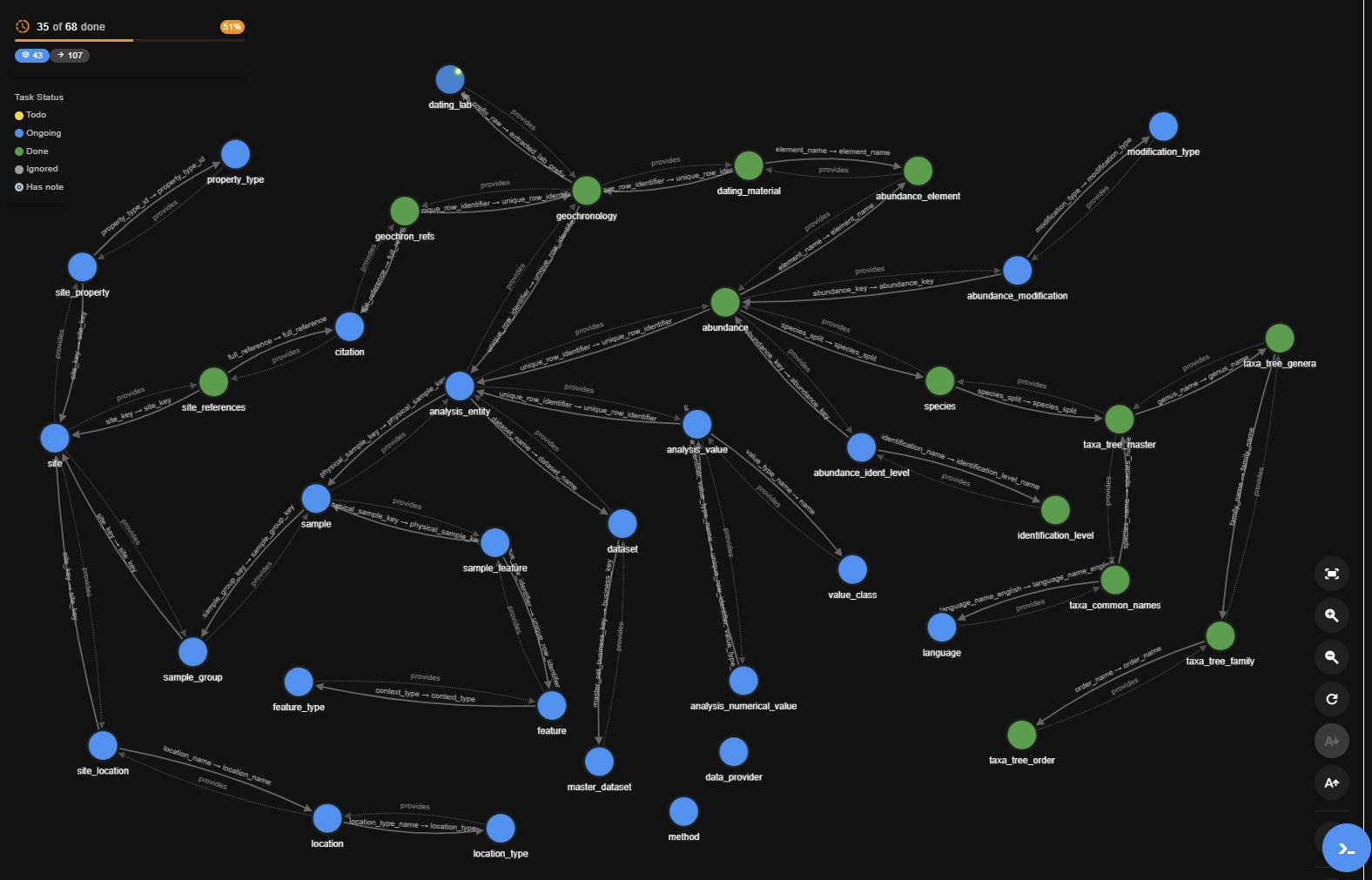
The table-form of the mapping:
| Column name | data mapping entity | Description | Comment |
|---|---|---|---|
| socken | Entity location | The name of the Swedish parish in which the site is located | |
| landskap | Entity location | the Swedish province in which the site is located | |
| place_name | Entity site | the name of the site (often the name of the village or farm name) | |
| raa_id | Entity site_property | Swedish National Heritage Board site ID, old version | |
| site_type | Entity site_property | The type of archaeological site | |
| site_id | Entity location | This column contains the Swedish National Heritage Board site ID (current version) | |
| uppdragsnummer | Entity site_property | The excavation project number | |
| lab_id | Example dataset mapping/Strucke Data-mapping/Entity sample_alt_ref where alt_ref_type = 3 = Lab Number this row also contains information need for Entity dating_lab | The unique id number assigned by the laboratory for each analysed sample | |
| c14_age_bp | Entity geochronology | The age, in number of years before present as determined by C14 analysis | keep all with blank dates, if it has a lab_id number, as the lack of date records an attempt to date |
| c14_error | Entity geochronology | the standard deviation of the given C14 age | |
| d13C | Entity geochronology | δ¹³C (delta C-13), ratio of stable carbon isotopes | |
| pMC_value | Entity analysis_value | percent Modern Carbon | |
| pMC_error | Entity analysis_value | The standard deviation of the pMC value | |
| c14_data_status | Entity geochronology | this seems to be an descriptive evaluation of the c14 data quality, with three possible values: - ok (29731 occurrences) - c14_data_status (470 occurrences) - modern date, no c14 data. (99 occurrences) - orealistiskt_c14_värde (1 occurrence) | |
| comment | Entity geochronology | additional information about the geochronology results | |
| assessed_relevant | Assessment in the archaeological report of whether the sample dating result corresponds with the archaeological feature. ‘N’ implies that the dating in the report does not agree with the dating of the site. It doesn’t mean that the dating is technically wrong. The age determination may very well be correct. (Contamination, random wrong choice of dated material. Misinterpretation of the context are some reasons.) | ||
| material | Entity dating_material, Entity abundance_modifications | The sort of material dated | This column contains both materials, and, sometimes, information about that material (e.g. was it burnt?) in the later case it counts as a “modification” to the material |
| species | Example dataset mapping/Strucke Data-mapping/Entity common_names, Example dataset mapping/Strucke Data-mapping/Entities/Entity Taxa | The species of the dated plant material, or of the animal whose bone was dated. In this data set typically given in the form of the Swedish common name for that species, but sometimes using a latin name. Use the “no data” taxon for all rows with no species. | Note that this column has the same name as a SEAD column, so all links point to the SEAD version |
| context_id | Entity features | The name or layer number of the archaeological context from which the sample was taken | |
| context_type | Entity feature_types | Archaeological context/feature type | |
northing_3006 | N/A | Northing coordinate (EPSG: 3006) | As the northing and easting coordinates are duplication of the information in the latitude and longitude columns in another format, we will not retain these columns when we do the data ingesting, as anyone who needs it in this format can simply convert |
easting_3006 | N/A | Easting coordinate (EPSG: 3006) | As the northing and easting coordinates are duplication of the information in the latitude and longitude columns in another format, we will not retain these columns when we do the data ingesting, as anyone who needs it in this format can simply convert |
| longitude | Entity site | the longitude of the site | |
| latitude | Entity site | the latitude of the site | |
| location_precision | Entity site | An description of the level of spatial accuracy of the coordinates. | |
cal_68_min | N/A | Calibrated age minimum (68.3% probability) | SEAD does not store calibrated results, as anyone can calculate them from the raw data. |
cal_68_max | N/A | Calibrated age maximum (68.3% probability) | SEAD does not store calibrated results, as anyone can calculate them from the raw data. |
cal_95_min | N/A | Calibrated age minimum (95.4% probability) | SEAD does not store calibrated results, as anyone can calculate them from the raw data. |
cal_95_max | N/A | Calibrated age maximum (95.4% probability) | SEAD does not store calibrated results, as anyone can calculate them from the raw data. |
median_cal_year | N/A | SEAD does not store calibrated results, as anyone can calculate them from the raw data. | |
calibration_method | N/A | SEAD does not store calibrated results, as anyone can calculate them from the raw data. | |
calibration_status | N/A | SEAD does not store calibrated results, as anyone can calculate them from the raw data. | |
| author | Entity biblio | the author(s) of the journal article which published the reported dates for this sample and/or information on this site | |
| publication_year | Entity biblio | the publication year of the journal article which published the reported dates for this sample | |
| title | Entity biblio | title of the journal article which published the reported dates for this sample | Note that this column has the same name as a SEAD column, so all links point to the SEAD version |
| journal | Entity biblio | the journal in which that article was published | |
| place_of_publication | Entity biblio | the city in which that journal was published |
- on 2026-08-18 I added two new columns, one for
material_editedand one formodification. These were made these by copying the originalmaterialcolumn, using Excel’s text to columns function to break that to columns at commas and spaces, and then for the ones that broke into more than two columns using the replace option to consolidate the extra words into the appropriate column. I also changed “förkolnat frö” to place “frö” in the material column and “förkolnat” in the modification column. The originalmaterialremains column unchanged, so my work can be checked. Indeed, this step will also be done in Shape Shifter, so this is more of a check to see if the results are as expected.